Jesus Chronicles
THE JESUS STORY
Restoring the records of the life and times of Jesus Christ
as preserved by esoteric literature and revealed guidance.
Esoteric teaching sometimes confirms and at other times conflicts with the orthodox Christian interpretation of the teachings of Jesus. It is hardly surprising that differences might arise over a two thousand year period in a story told and retold to people in every part of the globe. Inevitably in those early days, conflicts arose between Judaism and what would become Christianity. Sadly an insistence on individual scriptural interpretation of his words led to division and fragmentation of the church from its earliest times.
What is clear is that despite our determination to cling to our own dogmas his teaching has transformed the world, influencing not only Christians but all who seek justice and truth from a spiritual perspective. Those who find many contradictions in the orthodox teaching of the church can now examine the possibility that this is because the central tenet of the teaching Jesus gave is missing, having been systematically removed and finally eradicated over centuries.
Evidence that Jesus travelled to India, Tibet and Persia
YouTube Viewer Comment:
“Thank you for this video. It has answered so many of my questions and my seeking. Bless you and love to all!”
“Wonderful to learn of this, didn’t know anything about it, a really wonderful delivery and telling of the story and food for thought. I can't for the life of me understand why the christian churches would want to keep this hidden, no one has a monopoly on Jesus!”
Scientific research confirming the Shroud of Turin
“The video embedded in this article examines scientific studies of the Shroud of Turin that support the biblical accounts of Christ's crucifixion. Believers and skeptics alike will find it fascinating! Truly a remarkable contribution to human understanding of events from our past that affect us all. Highly recommended!”
Facebook comment: Saxony, Germany
Viewer Comments:
“ABSOLUTELY FABULOUS!!!!!“
Joseph G. Marino, Shroud Scholar, Researcher and Author
“Without the slightest quibble or qualification, absolutely, stunningly brilliant!!!!! It is far and away the best presented, the most authoritative and the most convincingly damning assessment of the carbon dating that I have come across throughout the last three decades. Normally I go glass-eyed when anyone tries to explain statistics, but the presentation of this video did it so well that even I managed to grasp most of the argument. It was all stated in such an even-handed, unsensational manner. The superbly created graphics kept my attention throughout….Outstanding throughout….”
Ian Wilson, Historian and author of several books on the Turin Shroud
Scientific research confirming Eucharistic Miracles
The teaching Jesus gave is designed to set us free from the manipulation and control of a power elite in every century who seek to limit knowledge and freedom. Why would this truth be omitted from orthodox scripture? Who would do such a thing and why? To discover that the very guardians of the Word were culpable is at the very least disconcerting, however for those who have invested their lives in following scriptural dogma it is shattering to the soul.
In an age where information is more freely available than ever before and global communication is possible we each have access to the accrued wisdom of the Ages. We can at last investigate for ourselves. Corruption infiltrates all institutions to a degree and comes in many guises, whether a priesthood, the pharmaceutical industry, bankers or global conglomerates. Ultimately the outcome rests on our willingness to accept personal responsibility and accountability for our actions. An understanding of the Law of Karma is the first step and this is the reason this teaching was removed from scripture in the first centuries AD. Most of us would agree that one life might be insufficient to balance past errors, a belief in Karma and rebirth is one which has continued through time because it is rooted in truth.
PALESTINE TO ENGLAND
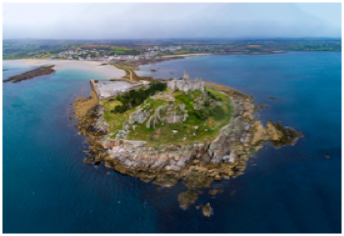
Historical annals relate that during his early life Jesus had visited England with his great uncle, Joseph of Arimathea, mentioned in all four gospels as the man who provided the tomb in which to lay the body of Jesus following the crucifixion. Joseph was so much more. A follower of Jesus, he was also a voting member of the Sanhedrin Council, responsible for the spiritual governance of the Jewish people, a body which officially wanted Jesus condemned to death, the affiliation therefore had to be kept secret. Roman records refer to him as ‘Nobilis Decurio’, denoting his rank as Minister for Mines, for Joseph was a wealthy tin merchant with trading links to Europe. It is a well documented fact that Britain, known as ‘Tin Island’, led the world in tin mining at this time and the islands were for a time afforded a degree of protection due to the valued trading connections which supplied Rome with the tin from which alloys were made. The island of Ictis, also known as Saint Michael’s Mount, was used by the Phoenicians, Greeks and Romans who had traded with Cornish tin miners since ancient times and was well known to Joseph, whose ships would have docked there to load their cargoes of tin.
Diodorus Siculus a Greek historian, wrote in the first Century: "Those Britains, who dwell near the promontory of Belerion (the ancient name for Cornwall and the Land’s End peninsula), live in a very hospitable, polite manner, which is owing to their great intercourse with foreign merchants. They prepare, with much dexterity, the tin which the country produceth…When it is refined, they cast it into ingots, in the shape of cubes, or dies, and then carry it into an adjacent Island, which is called Ictis. For when it is low water, the space between that Island and the Continent of Britain becomes dry land; and they carry great quantities of tin into it, in their carts. Here the merchants buy it, and transport it to the coast of Gaul...”
Legend states that Jesus accompanied his uncle on his journeys, on one occasion building a small wattle altar at Glastonbury, England which he dedicated to his mother Mary. The site was preserved and a wooden church was later erected over the original site, a fact confirmed by St Augustine over five hundred years later in a letter to Pope Gregory who had sent him to Britain to convert ‘the pagans’. Far from converting the native population, St. Augustine confirmed a thriving Celtic Christianity stating that he had ‘seen the aulde church with mine own eyes’. The first stone church in England was built over the site in the 7th century.
GLASTONBURY
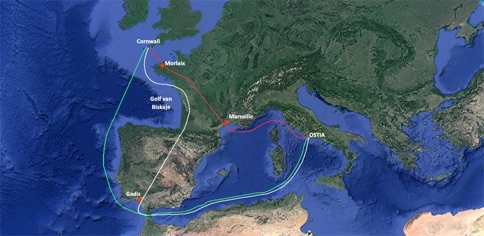
Following the crucifixion Joseph of Arimathea spent time in prison as a result of his allegiance to Jesus, whose followers were being mercilessly persecuted and hounded and forced to leave Palestine by the occupying Roman authorities. In AD37, along with a small band of disciples which included Mary Magdalene and Lazarus, he set sail to seek refuge beyond the authority of Rome, in the islands of 'Britaine' on the farthest outskirts of the Roman Empire where Joseph was already well regarded. In addition to Christians, Rome persecuted the Druidic Celtic tribes of Europe; an estimated one million Celts were killed with a further one million enslaved in the region known today as France. This forged an unbreakable alliance between the British and French Celtic Druids. Joseph and his group landed in Marseilles, France where they were met by a delegation of French Arch Druids. Lazarus and Mary remained in France and their links to the foundation of the early church there are historically documented. The main group continued on through Narbonne, Figeac, Rocamadour and Limoge to Marlaix where they were met by a delegation of British Celtic Druids led by Prince Aviragus of the royal Silurian tribe, of the Dukedom of Cornwall.

An interesting heraldic footnote: Among his many hereditary titles, Prince Charles is 'Duke of Cornwall', a title inherited from the ancient Celtic kingdom which was conquered by the emerging Kingdom of England. Prince Charles bestowed the title Duchess of Cornwall on his wife Camilla following their marriage.
Joseph and his companions were accompanied to England to ensure their safety. They landed at Marazion, Cornwall at the island of Ictis. Travelling through Devon and Cornwall and the Mendip Hills, they followed what is today known as 'The Michael and Mary Line’ a terrestrial ley line running South West across England. After boarding skiffs, (shallow hide covered rowing boats) they made their way via the River Brue and its tributary, the River Parret, through a marshy area of small islands known locally as Ynes Wyten or Avala, 'the place of apples', a fruit sacred to the Druids. 'Avalon' is derived from Avala and known today as Glastonbury.
Here Prince Aviragus granted a Royal Charter of ‘a perpetual gift of 12 hides of land’ one hide for each apostle, representing 160 acres each, a sum total of 1,920 acres. The disciples settled and established their first church which later became an abbey. The Glastonbury Charter' was the first land ever dedicated in the name of Jesus Christ. It is the only land in the British Isles designated tax free. This charter was renewed and enlarged by successive monarchs and is recorded in the Domesday Book, the historical record of land, property and goods commissioned by William the Conquerer in 1086.
The inscription in the Domesday Book reads:
"The Domus Dei in the great monastery of Glastonbury, called The Secret of Our Lord.
This Glastonbury church possesses in its own ville X11 hides of land which have never paid tax"
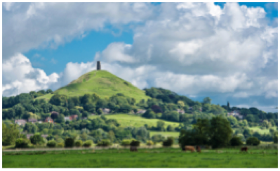
Legend states that as the weary travellers walked up the hill to Glastonbury Tor, Joseph planted his staff of Jerusalem Thorn in the ground. It took root and flowered each Easter until it was hacked down by Puritan forces in the English Civil War. Cuttings from the original thorn were salvaged by local people and hidden in secret locations in the town; one of the cuttings was planted on the original site of the Holy Thorn in 1951. Botanical experts have verified that the species as Crategus Monogyna Biflora, which originated in the Middle East.
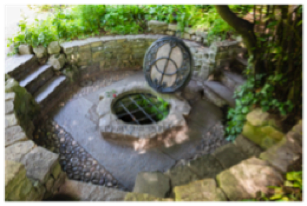
The devout Celtic Druids assimilated the new faith, eventually converting to join in establishing the first Christian mission beyond Jerusalem. Converts were baptised by water from the sacred Chalice Well in Glastonbury and by the ‘laying on of hands’ a tradition passed down from Jesus to the first disciples and continued by the Christian priesthood today. Celtic Christianity laid the foundations of the church for the first five hundred years; its founders were the Celtic kings and princes, a royal lineage baptised in the sacred Chalice Well for centuries. Today’s’ annual Glastonbury Festival is a reminder of the early Celtic Druidic history which merged with Christianity in the 1st century AD.
It is Glastonbury not Rome which remains the undisputed senior church of Christianity, a fact not disputed by the Vatican and demonstrated by seating arrangements at Vatican Conclaves. Precedence is always given to the English prelate in recognition of the origins of the Christian church, founded by Joseph of Arimathea at Glastonbury in 37AD and recorded in the historical annals.
THE ROMAN CHURCH
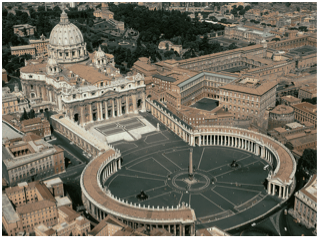
The teachings of Jesus spread world wide in the 1st century AD, the followers were persecuted unmercifully by successive Roman emperors who saw it as a challenge to their authority. The early Christians worshipped secretly in the catacombs of Rome as hundreds of thousands went to their deaths for refusing to deny their faith. The Roman church was established by evangelists from the time of Peter and Paul, who were repeatedly imprisoned for their beliefs.
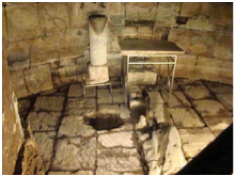
The Mamertine Prison
Following the burning of Rome in 64AD attributed to Emperor Nero, both disciples were put to death during the persecution which followed. Paul was reputedly beheaded in Rome, the epicentre of the Roman Empire and buried outside the city walls, commemorated by the church ‘St. Paul without the Walls’. Peter was imprisoned chained to a pillar for years in the notorious Mamertine Prison in Rome, before being crucified upside down on the site which is now the Vatican, where his death is commemorated by St Peter’s Basilica, the largest Christian church in the world.
HISTORY OF THE PAPACY
Contrary to popular belief Peter was never elected pope.
The legend derives from the words of Jesus –
‘Thou art Peter and on this rock I will build my church’
referring to his unquenchable faith.
The title ‘pope’ (meaning papa or father) was originally given to all regional bishops of the early church, Rome had significant prestige but held no precedence over other regions. The Apostolic Constitutions confirm Linus as the first bishop of Rome, ordained by Paul in 58AD, followed by Clement as the second pope ordained by Peter himself in his own words. The earliest list of the bishops of Rome comes down to us from St. Irenaeus who wrote c. AD 180 that "The blessed apostles, then having founded and built up the Church, committed into the hands of Linus the office of the episcopate." Eusabius described Linus as "the first to receive the episcopate of the church at Rome, after the martyrdom of Paul and Peter". (Episcopate is a term meaning ‘government of the church by its bishops’) However, from the late 2nd or early 3rd century the convention began of regarding Peter as the first pope.
The papacy itself was not established until 590 AD when Gregory the Great was elected Bishop of Rome, later granting himself the extended title ‘Pope and Head of the Universal Church’. Following his death he was succeeded by Pope Boniface who inherited the title and from then on the title ‘Bishop of Rome’ became accepted as denoting the Head of the global church.
CONSTANTINE - THE FIRST CHRISTIAN EMPEROR
In the first three centuries, the persecution of the fledgling Christian church continued. In 303AD the Roman Emperor Diocletian launched a vicious campaign in an attempt to annihilate what he perceived to be the cult of Christianity. Diocletian had introduced a power sharing system which resulted in the appointment of four junior Caesars, or deputy emperors, charged with governing the fragmenting empire. Constantius Chlorus, father of the future Constantine the Great, was one of them. Helena his wife was Christian and Constantius is described by the historian Eusabius as being secretly Christian. According to Celtic chronicles, Constantine the Great was the child of the union of a Christianised Roman general and a Celtic Christian mother.
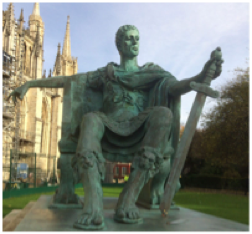
Constantine the Great - York Minster
Diocletian abdicated in 305AD leaving the deputy emperors of East and West jostling for power. In 306AD, following the sudden death of his father in York, England, Constantine an able general was unanimously acclaimed Caesar by the garrison. Emperor Galerius, the successor to Diocletian, confirmed the role and the power struggles between the junior Caesars continued.
312AD marked the Battle of Milvian Bridge which took place in Rome between Constantine and the emperor Maxentius. Constantine stated under oath that before the battle in which his troops were completely outnumbered he had a vision whilst praying. He saw a cross of light in the heavens above the sun, inscribed with the words ‘in hoc signo vinces’ (with this symbol you shall prevail).
Constantine ordered his soldiers to mark their shields with the insignia Chi Rho, formed from the first two Greek letters of the word Christ, Chi (X) and Rho (P). He also stated that next night Jesus appeared to him and commanded him ‘to make a likeness of that sign which he had seen in the heavens and to use it as a safeguard in all engagements with his enemies”.
Constantine fulfilled the message, a standard was designed which bore his image and those of his sons, it is described by the historian Eusabius: ‘A Description of the Standard of the Cross, which the Romans now call the Labarum.’
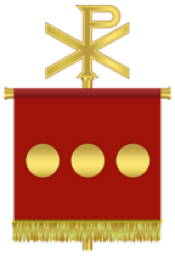
“Now it was made in the following manner. A long spear, overlaid with gold, formed the figure of the cross by means of a transverse bar laid over it. On the top of the whole was fixed a wreath of gold and precious stones; and within this, the symbol of the Saviour’s name, two letters indicating the name of Christ by means of its initial characters, the letter P being intersected by X in its centre: and these letters the emperor was in the habit of wearing on his helmet at a later period. From the cross-bar of the spear was suspended a cloth, a royal piece, covered with a profuse embroidery of most brilliant precious stones; and which, being also richly interlaced with gold, presented an indescribable degree of beauty to the beholder…”
"The emperor constantly made use of this sign of salvation as a safeguard against every adverse and hostile power, and commanded that others similar to it should be carried at the head of all his armies.”
Constantine became Emperor of the West in 312AD, signing the ‘Edict of Tolerance’ which granted freedom of religion to all in 313AD. This ended the persecution of the Christians, allowing them freedom of worship. In addition he united and promoted the faith, restoring land and property previously confiscated under Diocletian rule. One year later, York had its first Bishop along with the Bishops of Londinium (London) and Lindum (Lincoln), the fore runner of the global church hierarchy.
THE NICENE CREED
In 324AD Constantine became sole emperor. As the church hierarchy of bishops and deacons became established their influence grew. Constantine, a wily strategist sought to use the church as a stabilising influence in the empire but was increasingly dismayed by bickering and divisions among the bishops concerning doctrine and dogma. In 325AD Constantine called the 1st Ecumenical Council at Nicea (present day Iznik in Turkey) in an effort to attain consensus between the differing opinions. Not known to have held a particular view, the emperor grew impatient with the endless theological debate between those who believed Jesus to be human and those who believed he was divine. With his advisor Eusabius he announced a compromise solution decreeing that Jesus was ‘of one substance with the Father’. This statement of faith determined Jesus as uniquely ‘The Son of God’ and became the Nicene Creed, repeated daily in every Christian church to the present time. While his intervention united the universal church, a minority of bishops who refused to accept were banished.
Remembered as the first Christian Emperor, Constantine the Great, along with his mother Helena established many churches on sacred sites throughout the world, including the first Church of the Nativity in Bethlehem, the Church of the Holy Sepulchre in Jerusalem and St. Peters in Rome. The consequence of the emperor’s patronage and the merging of Church and State created a powerful alliance, with an emphasis on status, buildings and property which would eventually distort the true message of Jesus.
THE DONATION OF CONSTANTINE
On his death in 337AD, all of Constantine’s possessions as emperor had become the property of the church in Rome, establishing a precedent and further enhancing the materialism which became the symbol of the future church under emperors and eventually popes. In the eighth century, a forged document appeared to confirm Constantine’s bequest of his wealth to then pope Sylvester and in perpetuity his successors. While the authenticity of the document was questioned the forgery was used to validate the authority of the church to seize land, property and wealth throughout the Middle Ages. In 1440AD, philologist and Catholic priest Lorenzo Valla proved the document was indeed a forgery.
REINCARNATION REMOVED FROM THE BIBLE
For the first 500 years reincarnation was taught by the early church fathers as Christian doctrine. Clement of Alexandria, a faithful disciple of the apostle Paul, stated that the secret teachings Jesus had imparted to Paul included reincarnation. In 451AD, the 4th Ecumenical Council of Chalcedon attended by some 520 bishops, reinforced and codified the doctrine of Reincarnation.
Pope Vigilius tried to reconcile the decisions with that of the earlier Council of Chalcedon of 451AD and after some amendments had been made he agreed to accept the decrees. This signed the death warrant for reincarnation as a teaching by the church which has chosen to ignore it since that time.
The Constitutional validity of the 5th Ecumenical Council
has long been debated on the following grounds:
- Council decisions to be valid are approved by the popes.
- The refusal of the pope and bishops to attend due to no equal representation.
- No minutes of the deliberations were taken.
- The records are incomplete.
- The documents presented to the pope for signature were falsified.
- Pope Vigilius as head of the church signed the resolution under threat by the emperor.
Reincarnation has never been formally discussed by the church, no doctrinal pronouncement, Papal Encyclical or Papal Bull has ever been issued. The church has taken the position that 160 bishops must have signed the Canons condemning the false teaching before the council formally opened.
THE CRUSADES
First Christian Crusade - Elimination of the Cathars
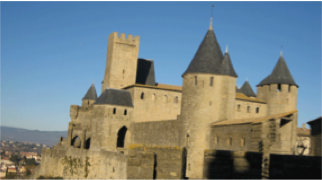
Castle of Carcassonne
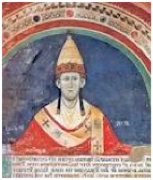
Pope Innocent III
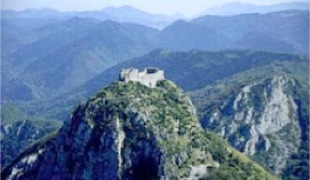
Montségur
Few people are aware that the first Christian Crusade was carried out in the 12th century AD against fellow Christians. The Cathars (also known as Cathari from the Greek Katharoi for “pure ones”) were a dualist medieval religious sect which flourished in Southern France, challenging the authority of the Catholic Church.
Cathars believed in two universal principles, similar to the Jehovah and Satan of mainstream Christianity, that human bodies are material objects made of earth and dust, but that our immortal souls are divine sparks. They believed in heaven, but not in hell. Cathars were also Gnostics who believed that divine knowledge is granted only to those who have perfected an inner understanding and connection through direct experience with the divine. Like the earliest Christians, Cathars recognised no priesthood but had a church hierarchy of ‘Perfecti’ following rites and ceremonies. Their focus was on meditation, fasting, hardship, poverty and good works. The Cathars were on a collision course with the Catholic church because they believed that the Roman Church worshipped materialism, had corrupted its own scripture, invented new doctrine and had abandoned the beliefs and practices of the early Church.
The Cathar movement attracted increasing numbers of followers including many wealthy aristocratic French families, at odds with Catholic dogma and materialism. Viewed by the mainstream church as heretics they became an increasing challenge to the orthodox church. Pope Innocent the 3rd initiated the Albigensian Crusade (1209 -1229) against the Christian Cathars of Southern France who were eradicated as a movement. It is estimated that during the twenty year period of this Crusade up to one million people were put to death for the crime of heresy i.e. refusing to follow church dogma. They were burned to death singly or in groups, in line with church dogma that ‘the church has never shed blood’. The Cathar genocide ended with the siege of Montségur where 200 Cathar perfecti were burned together at the foot of the mountain. Pope Innocent was enthusiastically advised that 20,000 Cathars had been massacred in the siege of Carcassonne
A remnant of their communities went underground and though suppressed survived. Today the Gnostic teachings survive, they can be found both within the church and without, as members of New Age spiritual communities, as writers, philosophers and activists intent on preserving the right to choose to worship in their own way. An eloquent demonstration of respect for the beliefs of all, while honouring the divinity of Jesus as ‘The Way, The Truth and The Light.’
For an in depth study of the above see:
Kindle ebook available from Amazon Stores
Nazareth: The Childhood Home of Jesus
On 22nd December 2009 Israeli archeologists announced that they have unearthed for the first time the remains of a 1st century dwelling from the Jewish village of Nazareth, the childhood home of Jesus. The excavation site is adjacent to the Church of the Annunciation, built to commemorate the place where according to tradition the Archangel Gabriel revealed to Mary that she would conceive a son by divine intervention. Gabriel is said to have appeared to Mary when she was going to collect water from the well. Interestingly the site has uncovered a two roomed house with a courtyard in which there is ‘a rock hewn cistern into which rainwater was conveyed’ providing support for the historical account. The excavation officially confirms the previously disputed existence of the hamlet of Nazareth to the era in which Jesus lived.
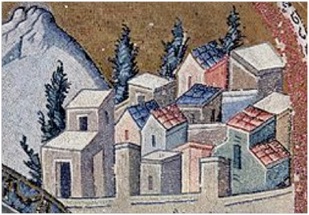
Ancient mosaic of the hamlet of Nazareth
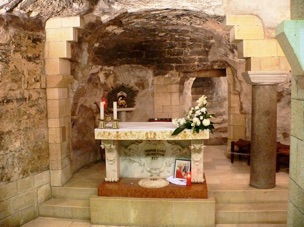
Crypt of the Church of the Annunciation
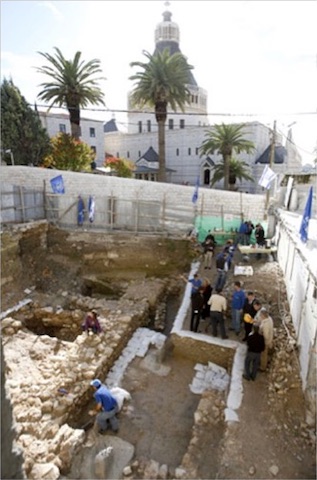
Excavation site in Nazareth with The Church of the Annunciation in the background.
The Nativity Story
The Nativity Story
The Nativity Story
See Spiritual Alchemy Blog ~
Epiphany
The 6th of January, the Feast of Epiphany celebrates the visit of the three wise men who paid homage to Jesus in the manger. As we leave Christmas behind us the story of the star which led the three kings to Bethlehem continues to raise many questions. Is there any evidence for the story? Curiously science has provided some intriguing clues, the following is offered for your interest.
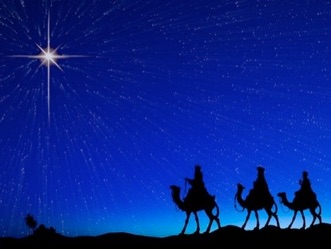
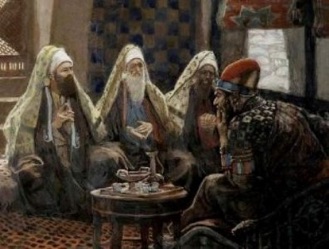
According to the story, the Kings went directly to Jerusalem where they began to enquire: “Where is he that has been born king of the Jews? For we have seen His star in the east and have come to worship Him”. King Herod then directed the Kings to the town of Bethlehem and told them: “Search diligently for the child and when you have found him, bring me word that I too may come and worship him”.
See Spiritual Alchemy Blog ~ Epiphany: An Astrological Interpretation
Jesus in Egypt
Joseph received a dream in which an angel appeared to him with a warning, saying: ‘Rise, take the child and his mother and flee to Egypt and remain there until I tell you. For Herod is about to search for the child to destroy him’. ...And he rose and took the child and his mother by night and departed into Egypt and remained there until the death of Herod.
Copyright © 1991 to 2025 Spiritual Alchemy